Social Learning Platform Analysis
Platform Choice & Justification
Living by myself has made my screen time on YouTube increase significantly. I am someone who feels more comfortable with background noise than silence, whether I am cooking, doing laundry, cleaning, going for a walk, or climbing. YouTube has been a great tool for this, as I usually listen to podcasts or watch gameplay videos and vlogs while going about my day. However, YouTube is more than just background noise for me. It has also helped me pass countless exams and complete projects. As a visual learner, I often search for visual explanations when I am struggling to understand a topic. If my professors can’t explain something in a way that works for me, I know I can turn to YouTube and find someone who explains it differently. I chose YouTube because of the variety of information and learning resources available on the platform, as well as the different ways people share their knowledge and experiences. YouTube can be considered a social learning platform because users can learn from others, ask questions in the comments, share their own knowledge, and connect with communities built around shared interests. Each channel has its own community where viewers can discuss content and learn from one another.
Analytical Framework
To build my analytical framework, I will use Bates’ SECTIONS model (Bates, 2015) to evaluate YouTube as a social learning platform. The model provides a framework for evaluating different aspects of a technology to understand how well it supports teaching and learning. Out of its eight criteria, I chose four that I felt were the most relevant to YouTube: Teaching Functions, Interaction, Networking, and Students. Each one draws on course readings to examine the learning opportunities YouTube provides, as well as its limitations.
Teaching Functions
This topic examines how effectively YouTube supports learning. Bui et al. (2023) discuss the cognitive, behavioural, and affective dimensions of learner engagement, which is what I will use for my assessment of YouTube’s teaching functions. This means looking at whether YouTube helps learners understand new information, apply their knowledge through activities such as following tutorials, and stay interested and motivated in what they are learning. I will also consider whether YouTube’s features help learners retain what they have learned and develop their understanding over time, rather than simply remembering information temporarily. The key question is: Does YouTube support meaningful learning that can lead to deeper understanding and skill development?
Interaction
This topic focuses on the role of communication and engagement in learning. To asses this, I will rely on Garrison, Anderson, and Archer’s (2000) Community of Inquiry framework, which highlights the importance of social and cognitive engagement in meaningful learning. Features such as comments, creator to viewer communication, and community discussions will be looked at to determine whether they encourage learners to exchange ideas, reflect on content, and develop their understanding. The analysis will also consider whether these interactions support meaningful learning or just serve as a space for sharing opinions and reactions. The key question is: Does YouTube support meaningful interactions that lead to deeper understanding?
Networking
This topic will talk about YouTube’s ability to support the development of Personal Learning Networks (PLNs). By looking at Rajagopal et al. (2011), I will analyze and explore how learners build and maintain connections with creators and communities that can support their learning over time. I will also consider how YouTube’s features help learners discover new learning resources and connect with people who share their interests. The key question is: Does YouTube help learners build and maintain networks that support continuous learning?
Students
This topics looks at how well YouTube meets the needs of diverse learners. Using the Universal Design for Learning (UDL) Guidelines (CAST, 2024), I will consider how YouTube supports accessibility, flexibility, and learner engagement, as well as the different ways learners can access and interact with content. I will also consider where YouTube’s features may create barriers for some learners. The key question is: Does YouTube provide an inclusive learning environment that supports a wide range of learners and learning preferences?
Platform Analysis
Teaching Functions
Bui et al. (2023) discuss the cognitive, behavioural, and affective dimensions of learner engagement, which can be used to evaluate YouTube’s teaching functions. YouTube is the second most popular search engine after Google, highlighting how much content and information is available on the platform. It offers lectures, tutorials, demonstrations, and explanation videos that help people learn and develop new skills. Since YouTube uses videos as its main format, it can provide visual and audio demonstrations rather than just text.
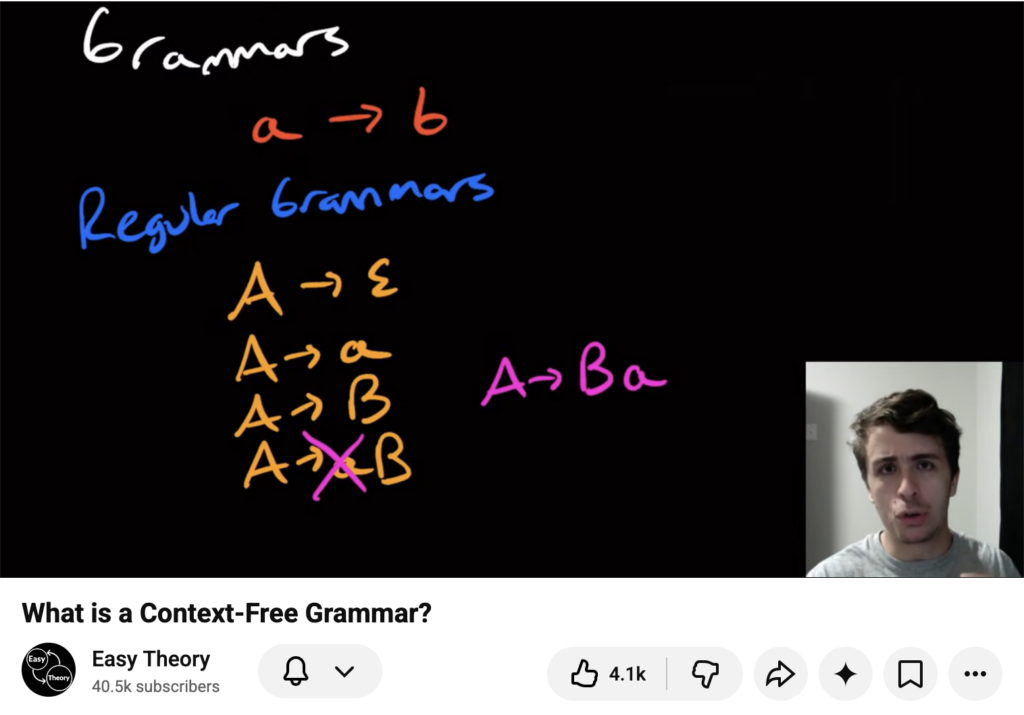
YouTube also encourages active learning. Many times when I am watching a video from Easy Theory, the creator often encourages me to pause the video and try a question myself before watching the explanation. If I get the question wrong, I can replay the explanation to help me understand it. Educational creators also use personal experiences, jokes, and visuals to make topics more engaging. YouTube’s algorithm can recommend similar educational videos, encouraging learners to continue exploring a topic. However, YouTube provides limited feedback and assessment, and unrelated recommendations or advertisements can distract learners from their goals.
Interaction
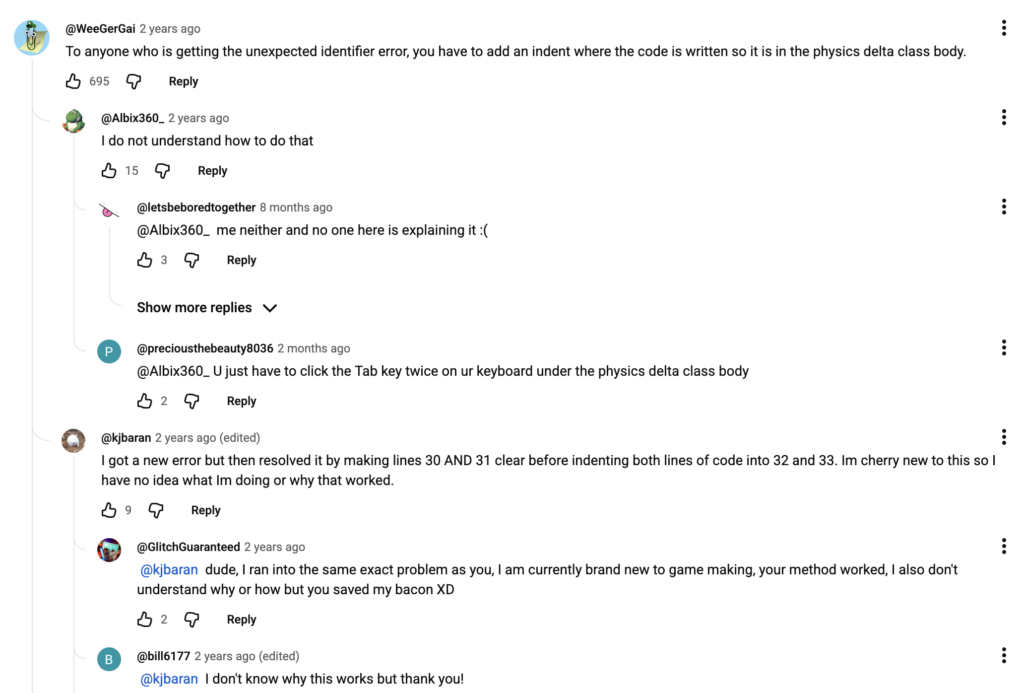
YouTube provides multiple opportunities to interact with others through comments, replies, community posts, and live stream chats. This connects to Garrison, Anderson, and Archer’s (2000) Community of Inquiry framework, which highlights the importance of social and cognitive presence in meaningful learning. The comment sections allow users to ask questions, share experiences, and discuss ideas with the creator and other viewers. For example, when learning how to create a 2D platformer game, I sometimes come across a problem that is not covered in the video. I can look through the comments to see if someone has had a similar experience and found a solution. However, these interactions can be inconsistent. When a channel has a large audience, it can be difficult for the creator to respond to every comment or question, meaning some learners may be left without answers.
Networking
Personal Learning Networks (PLNs) help learners access knowledge through connections with experts and communities, as discussed by Rajagopal et al. (2011). YouTube is a useful place to build a PLN because it allows users to subscribe to creators, follow educational channels, and discover related content through recommendations. Users can build their network by finding channels and creators that support their learning. While learning how to code, I subscribed to multiple coding channels, followed recommended creators, and participated in discussions with other learners in the comments.
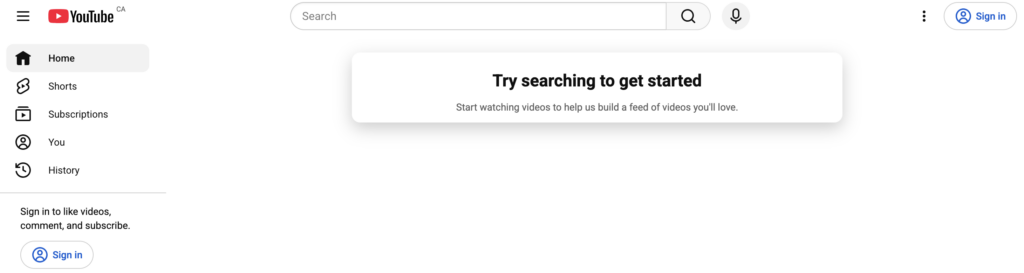
However, YouTube’s recommendation algorithm can also create limitations. Since it recommends content based on what users have already watched, learners may miss out on different topics or points of view. This can limit their exposure to new ideas and sources of knowledge.
Students
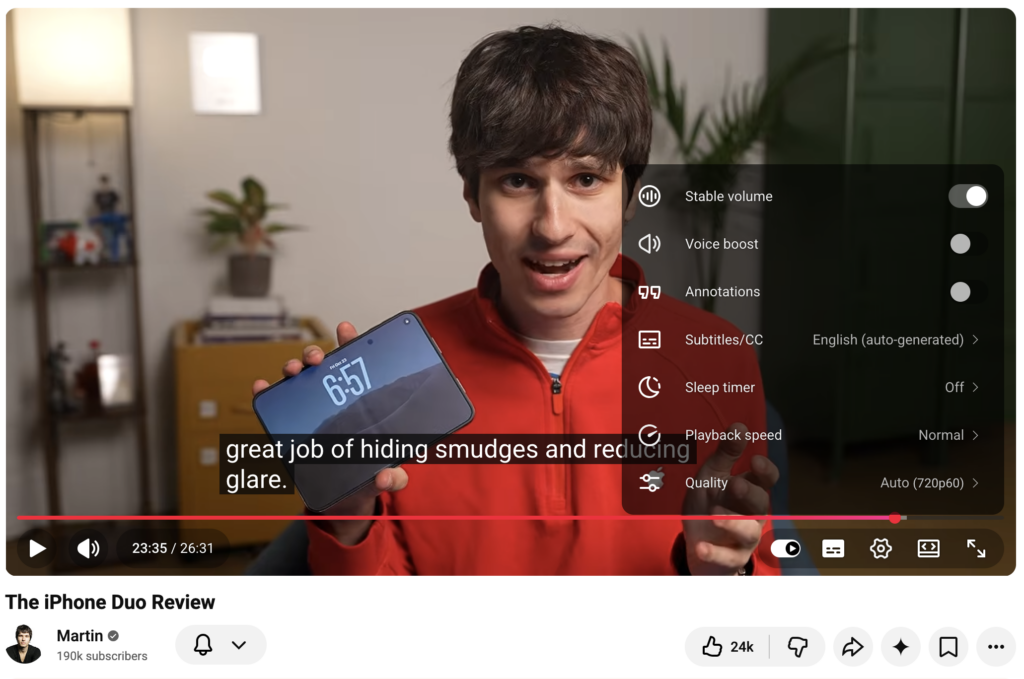
The Universal Design for Learning (UDL) Guidelines (CAST, 2024) talks about providing multiple ways for learners to engage with and access information. YouTube supports this by allowing users to pause, replay, speed up, or slow down videos, giving learners flexibility in how they engage with content. Captions also provide another way to access information. Personally, I prefer watching videos with captions because I find that I can focus better and understand what the person is saying more clearly. This connects back to UDL because offering different ways to access information can help learners find what works best for them. YouTube can be accessed through a web browser or an app, and users can watch videos without creating an account. However, learners still need a digital device and an internet connection, which can create barriers for those without reliable access to technology.
Reflection & Implications
Looking at YouTube through the four criteria in my framework has shown me that it is a great platform for self-directed learning. To answer each of my framework questions, YouTube can help learners understand topics and develop new skills, provide opportunities to interact with others, help learners build Personal Learning Networks (PLNs), and support different learning needs. For example, when I was learning how to code, I subscribed to multiple coding channels and followed recommended creators to find new resources. If I came across a problem that was not covered in a video, I could look through the comments to see if someone else had experienced the same problem and found a solution. I also find captions helpful because they make it easier for me to focus and understand what is being said. However, YouTube also has its limitations. Creators can’t always respond to every comment, recommendations can limit the different perspectives we are exposed to, and not everyone has access to a device or reliable internet. I also need to make sure I understand what I am learning and avoid getting distracted by unrelated videos or advertisements. This shows that even though YouTube provides many resources and opportunities to learn, it is still up to the learner to use them effectively. The same applies to other learning platforms, where having access to information does not always mean that meaningful learning will happen.
References
A.W. (Tony) Bates, & Bates, A.W. (2015, April 5). Chapter 8: Choosing and using media in education: The SECTIONS model. Tony Bates Associates Ltd. Teaching in a Digital Age. https://opentextbc.ca/teachinginadigitalage/part/9-pedagogical-differences-between-media/
Bui, H. P., Ulla, M. B., Tarrayo, V. N., & Pham, C. T. (2023). Editorial: The roles of Social Media in education: Affective, behavioral, and cognitive dimensions. Frontiers in Psychology, 14. https://doi.org/10.3389/fpsyg.2023.1287728
CAST. (2024). The UDL guidelines. CAST. https://udlguidelines.cast.org/
Garrison, D. R., Anderson, T., & Archer, W. (200). Critical inquiry in a text-based environment: Computer conferencing in higher education. The Internet and Higher Education, 2(2), 87–105. https://doi.org/10.1016/S1096-7516(00)00016-6
Rajagopal, K., Joosten-ten Brinke, D., Van Bruggen, J., & Sloep, P. B. (2011). Understanding personal learning networks: Their structure, content and the networking skills needed to optimally use them. First Monday. https://doi.org/10.5210/fm.v17i1.3559